Wednesday, February 13, 2013

Biography Book Report--Character Breakfast

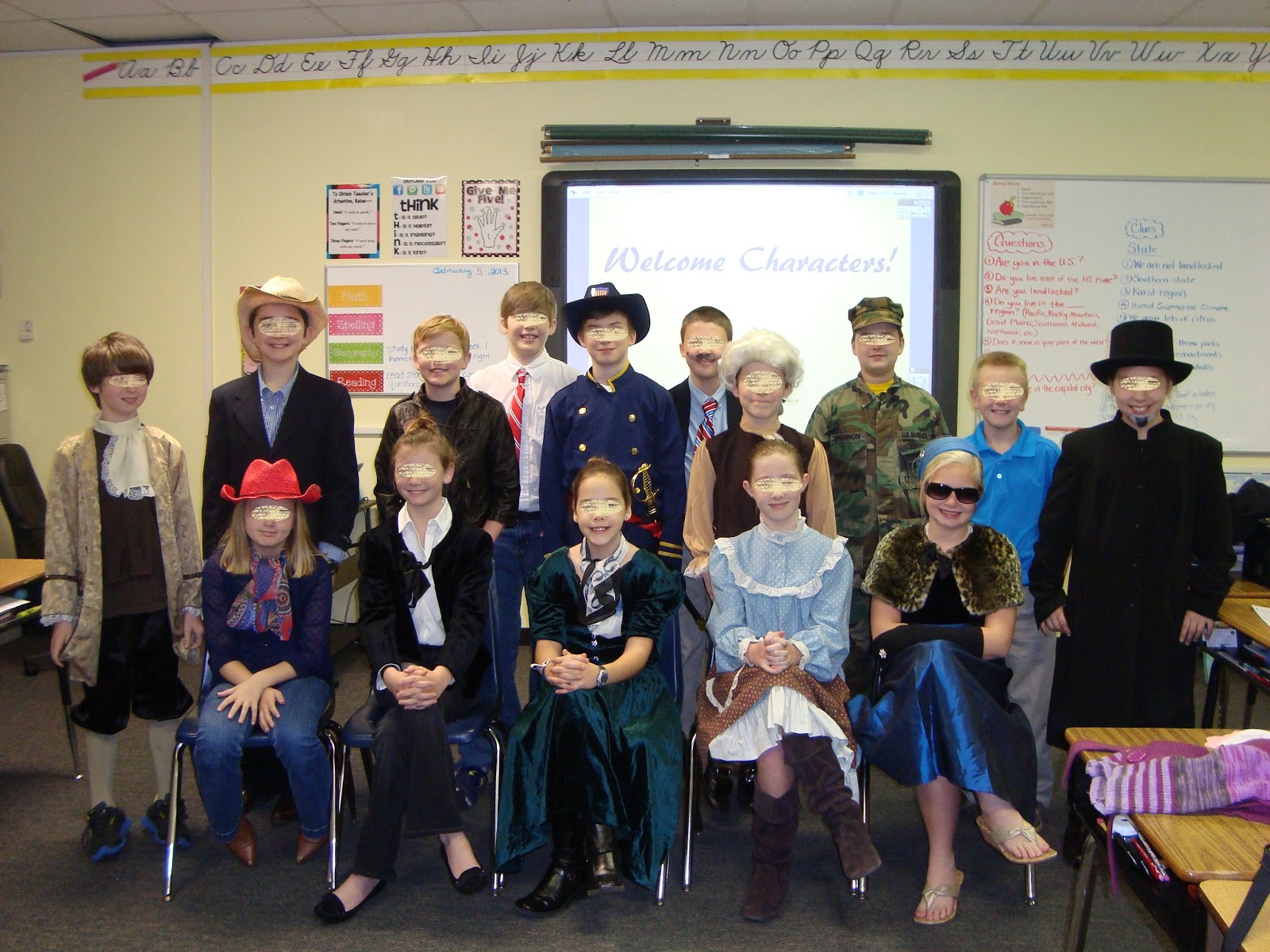
Each month, my students are assigned a book report.  For January's report, they had to read a biography book, come to school dressed as the book's character, and then make a presentation as that person.  The presentation had to be 1-2 minutes long and meet certain criteria.  We call this event a "Character Breakfast" because everyone is dressed as a book character and we eat breakfast during the presentations.  It is a fun event for everyone!  Since we learned about the presidents in the fall semester and are currently reading about the American Revolution, I limited their biography selection to presidents, the wife of a president, or a hero from the American Revolution.
 
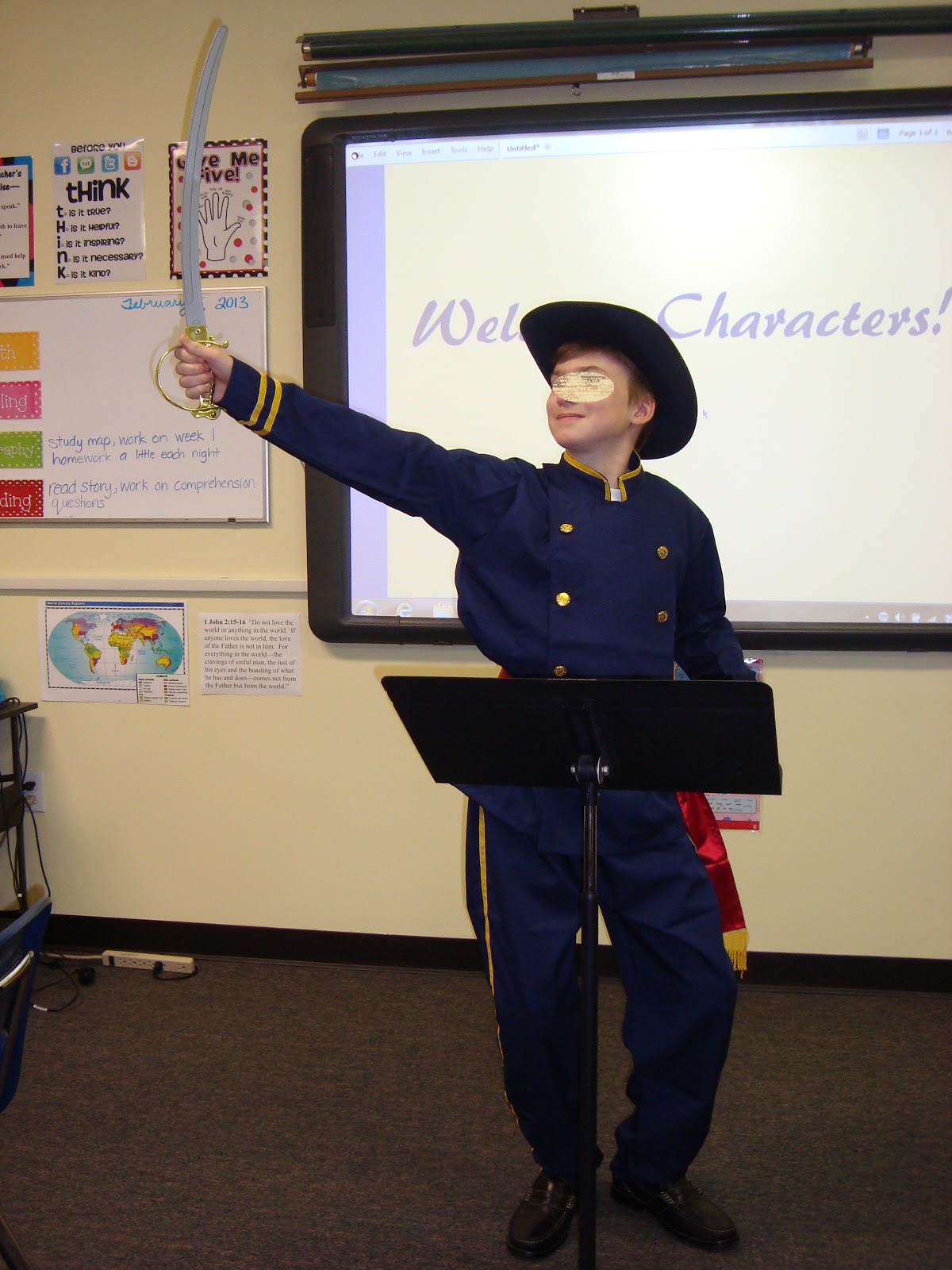
Here are a few of my boys:  (from left to right)  James Madison, John Adams, William Howard Taft, Dwight D. Eisenhower, Ulysses S. Grant, Bill Clinton, and George W. Bush.  (Not pictured: George H.W. Bush, Ronald Reagan, and John F. Kennedy)
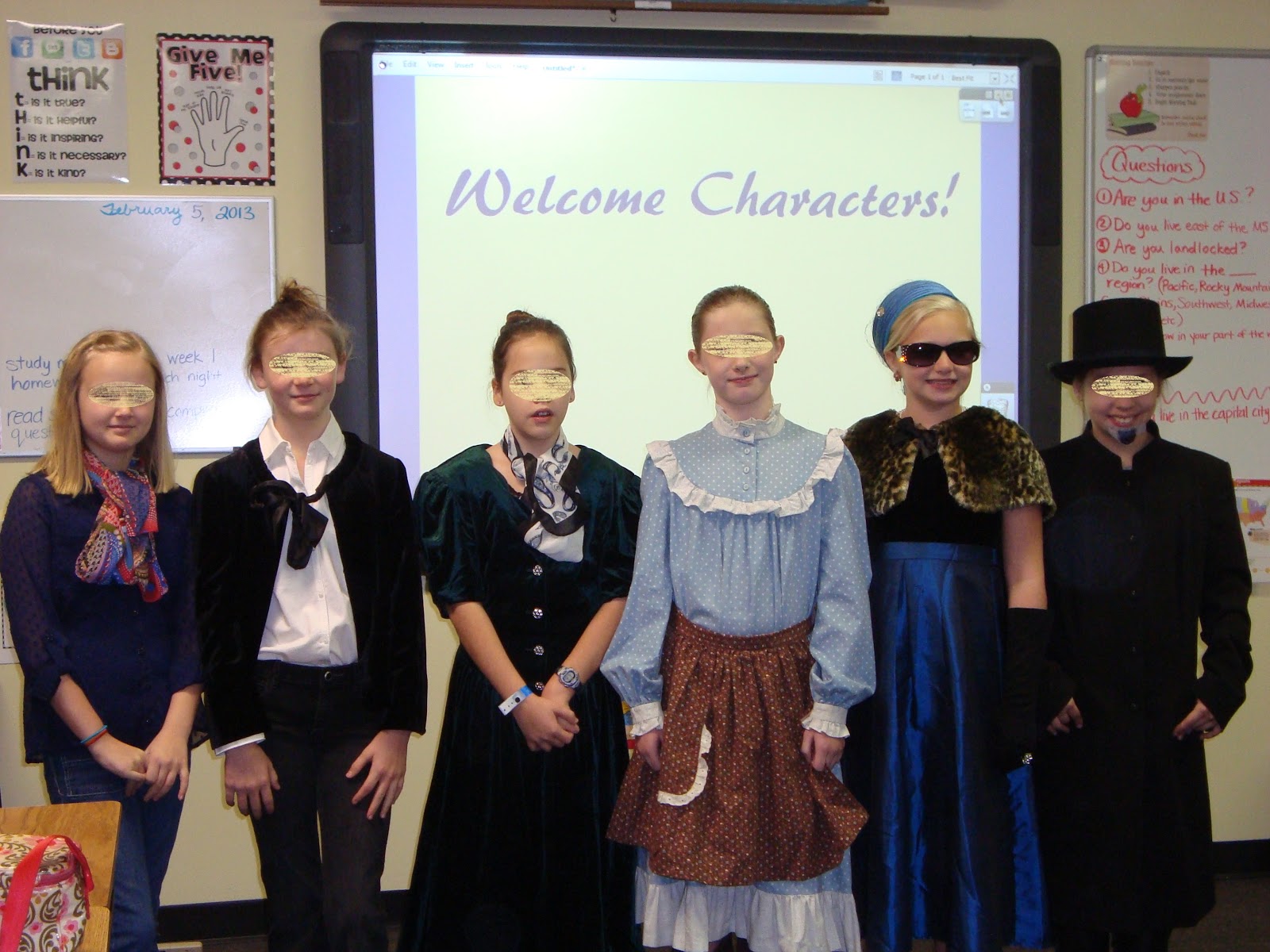
Here are my girls, from left to right:  Nancy Reagan, Laura Bush, Martha Washington, Abigail Adams, Jackie Kennedy Onassis, and Abe Lincoln.
 All together:
A few moms dropped off breakfast for us: hot chocolate, orange juice, fruit cups, coffee cakes, and a variety of donuts.  Yum!
The students did a great job presenting.  They thoroughly enjoyed this assignment and I was very pleased with how serious they took it.  I've been doing this report for several years and this has been my favorite Character Breakfast so far!
This was the first year that I limited their book choices.  In previous years, I allowed them to read a biography on whomever they wanted (Disclaimer: The book still had to be approved by the teacher!).  However, this year it worked out well to require them to focus on presidents/the wife of a president. 
They learned so much from this assignment and were all eager to share!
Throughout the presentation, the students had to stay in character.  They couldn't say, "I died in the year..."  My favorite ending was Lincoln's: "I'm so glad I was able to visit with you all today!  I have to leave soon, though.  I'm going to get ready for an evening out.  My wife and I are excited about going to Ford's Theater tonight to see a play called Our American Cousin."
 
I also enjoyed the Q&A time.  When John Adams was asked, "Weren't you afraid to sign the Declaration of Independence?  I mean, you could have been hung for treason!" he replied, "No!  I was so mad about the taxes and all they were doing, I couldn't wait to sign it!"  ha!

Wednesday, February 6, 2013

Digital Learning Day 2013

Image from Google
This year, February 6th is National Digital Learning Day.  Digital Learning is "any instructional practice that effectively uses technology to strengthen the student learning experience.  Digital Learning Day is one day that highlights this practice, but the hope is that it will continue year round."

I signed up to take part in this event, but I didn't plan anything over-the-top for my class.  I decided to keep it simple and focus on three things.  I introduced my students to glogs, showed them how to create a word cloud through Tagxedo, and got them started on KidBlog.  I gave my students a writing assignment this morning and asked them to share how they use technology to help them with schoolwork, explain what they like about the way I use technology in the classroom, and offer one suggestion on how I can improve my teaching (with technology).  I enjoyed reading their feedback and a few of them offered good suggestions.

I informed my co-workers of DLD and let them know that you don't have to have fancy tech tools (i.e. Promethean board or iPads) to participate.  You can simply introduce your students to a new website like www.flocabulary.com, observe in a technology-rich classroom, video-tape yourself teaching a lesson (and review it to improve your practice), or just get on Twitter and connect with other educators.

Here are a few sites that I found helpful: 
Save the date for February 5, 2014--the next DLD!

Friday, February 1, 2013

Latin American Festival

Yesterday, in 5th grade, we held our annual Latin American Festival. 
Here's how this two-week, in-class-only project works:  The students are grouped by twos and choose a Latin American country to research.  They are to write essays about the country's religion, government, history, living conditions, climate, landforms, etc. and then prepare a tri-fold board with this information displayed.  Once the boards are ready, we invite the 3rd and 4th grade students to listen to the 5th graders' presentations about their countries.  Food samples are provided by each group as Latin American music plays in the background; it's like a fiesta! 
The students have to know their assigned country well because they pretend to be from that country.  They had to choose a name for themselves (they looked up popular names from their countries) and that's what everyone called them at the Latin American Festival.  I printed out cute nametags for the students that read, "Hola! Mi nombre es..." which I found HERE.
The students did a great job staying in character during their 3-minute spiel.  I overheard another teacher ask one of my students about a wooden statue that was on display at her table.  She replied, "What do you mean, 'Where did I get this?' I brought it from my home in Honduras.  I traveled a long way to visit you today and thought you might like to see some things I own."  Ha!  In reality, the girl's mom had gone on a mission trip to Honduras and brought the statue back as a souvenir:
Not a single adult helped the students with their boards and I love that you can tell that 5th graders created the displays.  FYI, we always do our projects in class.
 Costa Rica's display was so creative; they had a zip-lining frog:
The festival lasted from 9:30-11:00 a.m., with different classes rotating through.  When the festival ended, 5th grade enjoyed the leftovers--taco soup, plantains, empanadas, papas rellenas, black beans and rice, cakes, cookies, and fruity drinks.  Yum!
We had such a fun time!  One student brought in a fake parrot that stood on his shoulder.  I tried to get a picture with him, but kept getting photobombed by another child!
Goals of this project:
  • Students will research a country in Latin America
  • Students will become familiar with several different types of research materials
  • Students will take notes and write summaries of information that they find in their research
  • Students will produce something interesting, informative, and fun from their research
Here are a few of the students' essays:
That afternoon, I had my students take part in a prayer time (something we call a "Prayer Furnace") for the countries of Latin America.  I set the boards around the classroom, put the students in their groups, had them go to each board, read what was written under the "Religion" section, and pray aloud, specifically for the prayer needs that were listed.  We had music in the background and would rotate every few minutes.
I prayed with several groups and then just walked around and listened to my students pray.  I was so touched by their powerful words.  Some of them are spiritually mature beyond their years.

We ended the day with prayer as a class and then sang a couple of worship songs.  It was a wonderful end to a wonderful day.


Sunday, January 27, 2013

Tropicana Speech Contest

Each year, my students participate in a speech contest that is sponsored by Tropicana and Florida 4-H.  This is actually a state-wide contest for students in grades 4-6.  I love this program because I get to teach my students how to write and deliver a speech.  I, myself, enjoy public speaking and believe it is a valuable skill to teach children. 
 
Students come up with a topic that interests them, research information, and then write a 2-3 minute speech.  I encourage my students to talk over topics with their parents, but all the research and writing is done in class.  This isn't always the case in other schools, but at CCS, we like to see what our students are capable of on their own. 
 
Topics must be approved by the teacher and I have even asked students to change their topics before.  I usually won't allow them to write about siblings, pets, or vacations (those seem like 4th grade topics).  I want them to choose topics that require a little research.  Students may not use the same topic twice.  Here are a few topics from my students this year:
  • The History of Basketball
  • The Benefits of Laughter
  • A Day in the Life of a Poison Dart Frog
  • Big Ben
  • Ballet IS a Sport
  • Taylor Swift
  • The Impact of Commercials
  • Harry Houdini
  • Music--The Magic Medicine
  • Oscar Pistorius
I always learn something new when we work on the speeches.  For example, I didn't have a clue who Oscar Pistorius was until a student told me he wanted to write a speech about him!
 
Once the speeches are written, we hold a classroom contest.  The teachers do not get to judge and sometimes I'm surprised by the results.  Three students are chosen from each class to move on to the school-wide contest.  This year, my top three speeches were The History of Basketball, The Impact of Commercials, and Music--The Magic Medicine.  For the past three years, one of my students has won the school contest and advanced to the county level. 
This year, the student who wrote his speech on The Impact of Commercials won the school-wide contest!  Yesterday, I went to cheer him on at the county level and he actually won Most Humorous Speech!  I am one proud teacher!  Even though I've had several students advance to the county level, none of them have ever placed at this level.  We were so excited!
To learn more about this program and check out resources for teaching public speaking, CLICK HERE. 
Does your elementary/middle school teach public speaking?  Do you have any helpful resources that you could share?  

Friday, January 25, 2013

Exit Ticket Strategy

The Exit Ticket Strategy allows students an opportunity to write down what they learned from the day's lesson(s) and may be used in a variety of ways.
 
Until this week, I had been doing verbal exit tickets to monitor my students' learning.  As my class would line up to go home, I'd turn to each one and have them tell me one thing they learned throughout the day.  No one could repeat a statement.  If a child said something like, "I learned how to add fractions with common denominators," I would give them a problem to solve or have them give me an example.  This took way too long, so I decided to use Post-It Notes as my Exit Tickets.
 
I transformed the inside of my classroom door so my students have a place to put their tickets before they leave:
Each of my students have a number assigned to them.  At the end of the day, the students are given 2-5 minutes to complete their Exit Ticket and then they stick it over their number.  This way, I can quickly see who has finished and who hasn't. 
I don't grade the Exit Tickets; they simply help me check for understanding and allow me to see which lesson the students found most memorable.
For more ideas on how to use Exit Tickets, click HERE.  For more information, plus printable Exit Tickets, click HERE.  

Friday, January 18, 2013

Our First Mystery Skype

On Tuesday, my class participated in our first Mystery Skype.  If you don’t already know, Mystery Skype is an activity in which two classes Skype and try to figure out where the other is located.  We guessed each other's state, city, and school.  This is done by having the students come up with clues about their location and asking yes/no questions.  Students must think about the clues they are given and then study maps in order to rule out certain places and make educated guesses.  This activity is student centered and the teacher acts as a facilitator.  
 Benefits of Mystery Skype:
  • Geography comes to life for the students.  It’s interactive; they learn about other states or countries in the world by having a conversation with the people who actually live there.  This is much more interesting and engaging than reading from a textbook!
  • With this activity, students are able to put to use their geography skills and see the value in knowing their cardinal/intermediate directions, how to read a map, etc.  I remember asking the students, “Do you see why it’s important to know where you are in the world?”
  • Students practice critical thinking skills.  They must brainstorm and create good questions for the other class.  They must use clues and deductive reasoning to figure out possible places where the other students are located.
  • Students practice communication skills.  The children must communicate effectively with those in their classroom and those on the computer in order to progress through the activity.
  • Encourages collaboration
  • Integrates technology and helps make global connections

Drawbacks of Mystery Skype:
  • It is easy for students not to participate and let someone else do all the work. 
  • It is difficult to hold each child accountable.

Mystery Skype is a wonderful activity.  However, I had some challenges during my first Mystery Skype and I’m going to share my honest reflections here.  I’ll also share my plan for improvement, as I’ll definitely be trying Mystery Skype again.
 
Everything I had read online about Mystery Skype beforehand gave me information on jobs/roles for the students so I mainly focused on that.  I made sure every child had a job and knew what his/her role was.  I’ll tell you the jobs I used, but know that I will probably change these for the next Skype session.  Here goes:
Greeter—Greeted the other class and shared a few clues about our location without giving it away
Orators—Asked/answered the questions and were the voice of the classroom (I didn’t want everyone shouting out answers, so I assigned two people to speak)
Inquirers—Came up with the questions to ask the other class.  They worked closely with the orators.
Typists—Two students were stationed at the computer to transcribe questions and answers.  They were taking the “minutes.”  
Google Mappers—Used maps on the iPads to try to piece together clues
 
Think Tank—Group of students who discussed the clues and tried to think through possible locations.  They were given maps to write/draw on.
Clue Keepers—Worked closely with the Google Mappers and Think Tank to keep up with clues.  They also sent information to the inquirers and orators.
Messenger—This student went from group to group, relaying information.
Photographer—Took pictures throughout the activity
Closer—Responsible for ending the call politely
Mathematician—Recorded the start/stop time of the call; when the activity was finished, this student used MapQuest to find the distance between our locations and the length of time it would take to drive from our school to their school.

I learned a great deal from this activity.  I, unfortunately, had made a lot of assumptions before our Skype call which caused me to be disappointed with my class’s participation in the activity.  First of all, I assumed they knew all the states and their locations.  They supposedly learned this last year.  However, they ended up having difficulty identifying locations on the map they were given.  I learned that I need to show maps every day and continue to talk about places in the world.  I can’t just say, “Oh, well they should have learned that last year” and not continue to reinforce the concepts.

I assumed my students knew how to search for information online.  I learned a few days ago, however, that their Internet search skills are limited.  I was also shocked to find out that they are not allowed to go on the Internet when they visit the computer lab for special area.  Instead, they focus on keyboarding.  I don’t have a set of computers in my classroom so I’ve never really had the chance to see many of my students try to navigate the Internet.  We will definitely be working on that!
I assumed that if each child had a job, they would take the task seriously and try to do their job well.  Negative.  I learned that when given a little bit of freedom, some of my students will take the opportunity to be silly.  At one point, I had a student holding a large map over his head and making random noises.  He wasn’t trying to help his classmates and wasn’t really listening to the other class.  He wanted attention and was trying to distract others.  I learned that I need to consider each child’s strengths and weaknesses and choose my students’ jobs carefully instead of randomly assigning them.  

My first Mystery Skype was definitely a learning experience and didn’t go as smoothly as I had hoped!  I had high expectations because my class is bright, polite, and usually very well-behaved.  They were nervous and excited though and neither of us knew what to expect.  The activity turned chaotic and confusing at times, which was frustrating.  

If I do this again:
  • I will practice before connecting with another class!  I will think of a country (or state) somewhere in the world and offer clues about the location to my students.  I will have them create questions to ask, examine maps, etc. and we will do a simulated “Mystery Skype” activity with just us.   
  • I will have my students come up with some behavioral rules/guidelines beforehand and make my behavioral expectations crystal clear. 
  • I will make sure my students know facts about their state/city inside-out!  They had a tough time coming up with clues for the other class to guess.
  • I will give more children the opportunity to come up to the computer, introduce themselves, and speak into the microphone.  During our first Skype, I had assigned only two students to speak.  Even though all my students could be seen in the background, I realize now that every child needed the opportunity to talk to the other class and next time, I’ll let them.     
I definitely have a better idea of how Mystery Skype should go.  I look forward to trying it out again!

Friday, January 4, 2013

Reading Fluency and Music

I have finally finished a project that I've been working on over the Christmas break.  I was inspired by THIS article (titled "Using Music to Improve Reading Fluency") to create a "songbook" of sorts in order to help my students improve their reading.
I decided to follow what the article suggested and select a variety of songs that were appropriate and engaging for my students to sing/read along with.  Do you know how hard it was to find a selection of wholesome songs for 5th graders?!  I wanted fun, catchy tunes from different genres and years with no innuendos or mention of love or boyfriend/girlfriend relationships.  I wanted a variety of tempos and songs with good vocabulary.  The songs also needed to be ones that the students were not so familiar with that they have already memorized the lyrics. 

Once I decided on my songs, I downloaded the MP3's.  I looked up song lyrics from a variety of websites and simply copied them into a Word document.  Most of them contained errors, so I had to do some editing.  I ended up with 30 songs.  Here's my list:

1.  “Good Morning” by Mandisa (feat. Toby Mac)  (2011)
2.  "Over the Rainbow" by Judy Garland (1939)
3.  If I Only Had a Brain/Heart/Nerve Lyrics (Wizard of Oz--1939)
4.  "Be Prepared" (Disney's The Lion King--1994)
5.  "Friend Like Me" (Disney's Alladin--1992)
6.  "Under the Sea" (Disney's The Little Mermaid--1989)
7.  "A Spoonful of Sugar" (Disney's Mary Poppin--1964)
8.  "Be Our Guest" (Disney's Beauty and the Beast--1991)
9.  "Rock Around the Clock" by Bill Haley (1954) 
10.  "Yakety Yak" by The Coasters (1958)
11.  "My Favorite Things" by Julie Andrews (from the musical The Sound of Music--1965)
12.  "Don't Worry, Be Happy" by Bobby McFerrin (1988)
13.  "Lean on Me" by Club Nouveau--1987 (original by Bill Withers in 1972)
14.  "Feeling Good" by Michael Buble--2005 (original by Cy Grant in 1965)
15.  "Hard to Believe" by VOTA (2008)
16.  "Forgiven and Loved" by Jimmy Needham (2008)
17.  "Old Time Rock and Roll" by Bob Seger (1978)
18.  "Psalm 145" by Shane and Shane (2001)
19.  "Istanbul (Not Constantinople)" by The Four Lads (1953)
20.  "I Can See Clearly Now" by Jimmy Cliff--1993 (original by Johnny Nash in 1972)
21.  "D.A.N.C.E." by Justice (2007)
22.  "Here Comes the Sun" by The Beatles (1969)
23.  "Pure" by Superchick (2005)
24.  "Who I Am" by Jessica Andrews (2000)
25.  "Carol of the Bells/Sing We Now of Christmas" by Barlow Girl (2008)
26.  "The World's Greatest" by R. Kelly (2002)
27.  "Johnny B. Goode" by Chuck Berry (1958)
28.  "Surfin' USA" by The Beach Boys (1963)
29.  "Fun, Fun, Fun" by The Beach Boys (1964)
30.  "Seminole Wind" by John Anderson (1992)

You can see that I have a mix of music--some Christian, some secular, some old, some more recent.  I focused on songs from Disney movies for a while.  They actually have great vocabulary in them!  I concluded with a country song that I'm sure none of my students have heard, but it's about Florida and we are actually in Seminole country, so it's fitting.  I plan on talking about musical genres and discussing the meanings behind the lyrics.  We will also discuss vocabulary and I can even pull in some geography with "Istanbul (Not Constantinople)" and "Surfin' USA."        

Finally, I was so intrigued by the Scholastic article that I did some research and learned about Shirley Handy, a veteran teacher who has led a workshop called "The Singing-Reading Connection" since 1989.  Wow!  I also found an old article by Gayla R. Kolb titled, "Read with a Beat: Developing Literacy through Music and Song."  The workshop and article are geared toward teachers of younger students, but I still have some struggling readers in 5th grade so I found them helpful.  I look forward to integrating music with our fluency practice and seeing how my students respond.